You don't need a machine learning engineer to ship AI features. You probably never did.
The gap between "we should add AI" and actually shipping something useful is mostly a hiring myth. ML engineers build models. You don't need to build a model. You need to call one. That's a very different problem — and a much cheaper one to solve.
Here's how to think about it.
Start With the Problem, Not the Technology
Most founders approach this backwards. They see competitors slapping "AI-powered" on their landing pages and panic. So they start asking: what AI can we add?
Wrong question.
Ask instead: where in our product do users hit friction, make mistakes, or do repetitive work? That's where AI earns its place. If you're building a project management tool, maybe that's auto-summarising meeting notes. If you're running a hiring platform, maybe that's screening candidates against a job description. The use case drives the implementation, not the other way around.
Pick one specific workflow. Solve that first.
APIs Do 90% of What You Actually Need
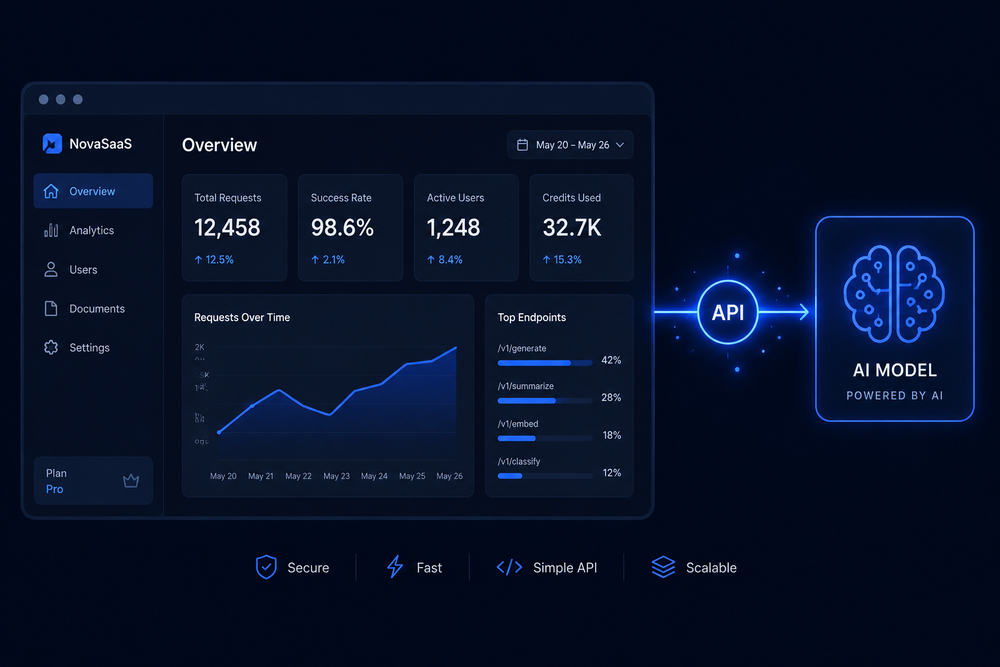
OpenAI, Anthropic, Google, and others have already trained the models. You're not reinventing anything. You're connecting your product to an API and writing good prompts.
For most SaaS use cases — content generation, document analysis, classification, summarisation, Q&A over data — that's genuinely enough. You write a prompt, pass in the user's context, get a structured response back, and render it in your UI. Done.
The technical complexity is closer to integrating Stripe than building a payments processor. Your existing developer can handle it. If you don't have a developer, a good agency or fractional CTO can scope and ship the first AI feature in a few weeks.
Where you do need more expertise: fine-tuning, custom embeddings, retrieval-augmented generation at scale, or anything involving proprietary data that can't touch third-party APIs. But those are version-two problems for most early-stage products.
What You Actually Need to Ship
Let's be concrete. To add a working AI feature to your SaaS, you need:
- A clear user problem and a defined output (what should the AI produce?)
- An API key from whichever model fits your use case
- A prompt that's been tested and refined — this takes hours, not weeks
- A way to pass user context into the prompt (data from your product)
- Basic guardrails: error handling, rate limiting, cost monitoring
That's the full list. Nothing on it requires a machine learning background. It requires clear thinking and someone who can write clean integration code.
Cost monitoring matters more than people expect. AI API costs can spike fast if you're not watching them. Set hard limits early. Log every call. Know your per-user AI cost before you scale.
The Prompting Layer Is Your Actual Moat
Here's something most founders miss: the model itself isn't your competitive advantage. Everyone has access to the same GPT-4 or Claude. Your advantage is the context you feed it.
Your proprietary data, your understanding of your users' workflow, the specific way you frame the task — that's where differentiation lives. A generic "summarise this" prompt is useless. A prompt that says "you are reviewing a SaaS founder's customer interview notes and your job is to extract unmet needs, grouped by user persona" is actually valuable.
Spend real time on prompt engineering. It's a high-leverage activity that requires domain knowledge, not ML expertise. You, as the founder, are often better positioned to write the right prompts than an engineer.
When to Get Help
You should bring in outside help when:
- You've identified the use case but don't have the technical capacity to ship it
- Your first AI feature shipped but you're not sure how to scale it safely
- You're making architecture decisions that will be painful to undo later
- You're evaluating which model or approach is right for your specific use case
You don't need to hire full-time. A fractional CTO or a small studio engagement can get you from idea to working feature faster than a hiring process alone.
The goal is a working, testable feature in front of real users. Everything else is secondary.
If you want to talk through where AI fits in your product and what it would actually take to ship it, book a free call with us at novion.one.