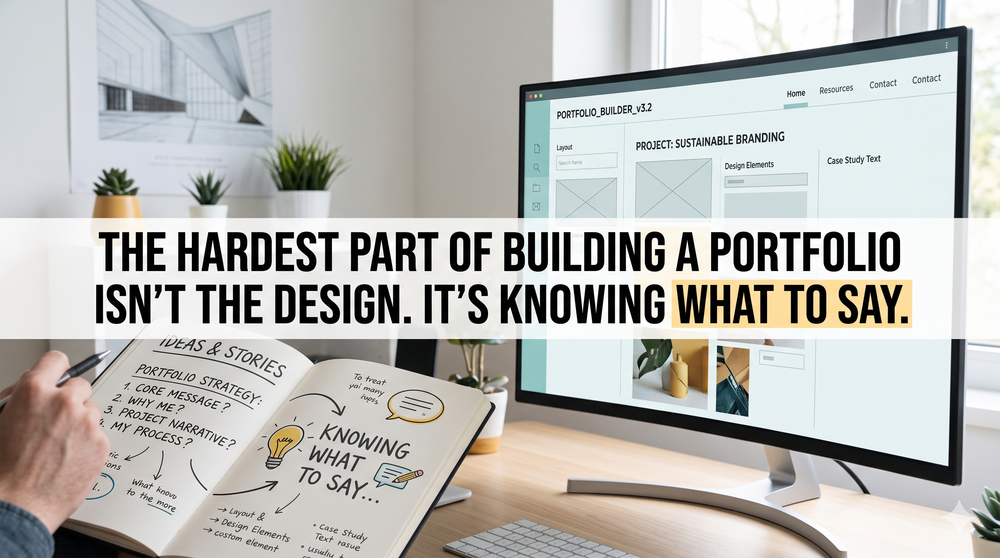
You've picked the template. You've set up the domain. You've got a color palette you're happy with. And then you open the "About Me" section and stare at a blank field for forty minutes before closing the tab.
This is where most portfolio projects actually die. Not at the design stage. Not at the technical setup. At the moment you have to describe what you do and why someone should hire you.
Why writing about yourself is so hard
There's a well-documented reason this feels impossible. Studies consistently find that around 70% of people experience imposter syndrome at some point in their careers, and job seekers are among the most affected groups. When you doubt whether your work is genuinely impressive, every sentence you write about yourself feels either dishonest or embarrassing.
The result is usually one of two failure modes. You undersell so aggressively that the portfolio communicates nothing useful. Or you copy the language pattern of every other portfolio on the internet: "I'm a passionate, results-driven professional with a proven track record of..." which is technically accurate and completely meaningless.
Neither gets you hired.
The blank page is a structural problem
The copy problem isn't about confidence, despite what every career coach blog will tell you. It's structural.
When you sit down to write about yourself, you're being asked to do three things at once: recall what you've done, decide what's worth mentioning, translate that into language that will land with a stranger reading for 30 seconds. That's a hard cognitive task under normal circumstances. It's nearly impossible when you're also worried about sounding arrogant, picking the wrong angle, or just getting the words to flow at all.
What makes it structurally harder is that your CV already has the raw material. Every job title, every project, every skill is right there. But a CV is a list. A portfolio needs a story. And the gap between those two forms is where people get stuck.
Over 80% of hiring managers review a candidate's portfolio or online profile before reaching out. They're not looking for a list of credentials. They're looking for a signal that you understand your own value and can communicate it clearly. That signal lives in the copy, not the layout.
What "good portfolio copy" actually does
A well-written portfolio bio does three things quickly:
It names the type of problem you solve. Not your job title. Not your years of experience. The kind of problem. A frontend engineer who says "I build interfaces that make complex data readable" is immediately more useful to a reader than one who says "5 years of experience in React and TypeScript."
It gives one concrete proof point. Not a list of achievements. One thing. The campaign that doubled signups. The refactor that cut load time by 40%. The redesign that a CEO screenshot-shared in a company all-hands. One real thing, stated plainly.
It sounds like a person wrote it. This is harder than it sounds. The tendency when writing formally about yourself is to strip out anything that sounds personal. The result is copy that reads like a LinkedIn summary generator ran twice. Readers notice the flatness immediately, even if they can't name it.
Why AI-generated copy has the same problem (and how to avoid it)
The obvious move here is to paste your CV into ChatGPT and ask for a portfolio bio. And you will get one. It will be grammatically correct, structurally sound, and completely indistinguishable from the bio generated by the person who applied to the same job two minutes after you.
The issue is that general-purpose LLMs don't know what voice to write in. They default to "professional LinkedIn tone," which is the same median output problem that produces identical-looking portfolio designs. The model hasn't been told whether you're a dry technical writer, a warm storyteller, a blunt builder. So it picks the middle.
The fix is constraints. Give the model a voice to write in, a template to write for, and a specific copy job to do. Then it produces something that actually sounds like it belongs to a person.
This is what the copy engine in CV2Folio does differently: it reads your CV, picks a design archetype with a specific editorial voice, and writes copy in that voice, not in "generic professional." A Terminal CLI portfolio gets direct, technical, jargon-comfortable copy. A Storytelling portfolio gets first-person narrative. An Editorial portfolio gets the kind of precise, unhurried sentences you'd find in a magazine profile. The model's job is narrow enough that it can do it well.
The practical upside
This matters beyond the portfolio itself. Once you have copy that actually articulates what you do and why it's valuable, it becomes reusable. Your LinkedIn headline improves. Your cover letter intro gets tighter. The answer to "tell me about yourself" in an interview becomes something you can actually say out loud without flinching.
The portfolio bio is hard because it forces you to make a claim about your own value. That's uncomfortable. But it's also the exact work that compounds across your entire job search once it's done.
The blank page problem is real. The good news is that your CV already contains the raw material to solve it. The gap is just the translation.