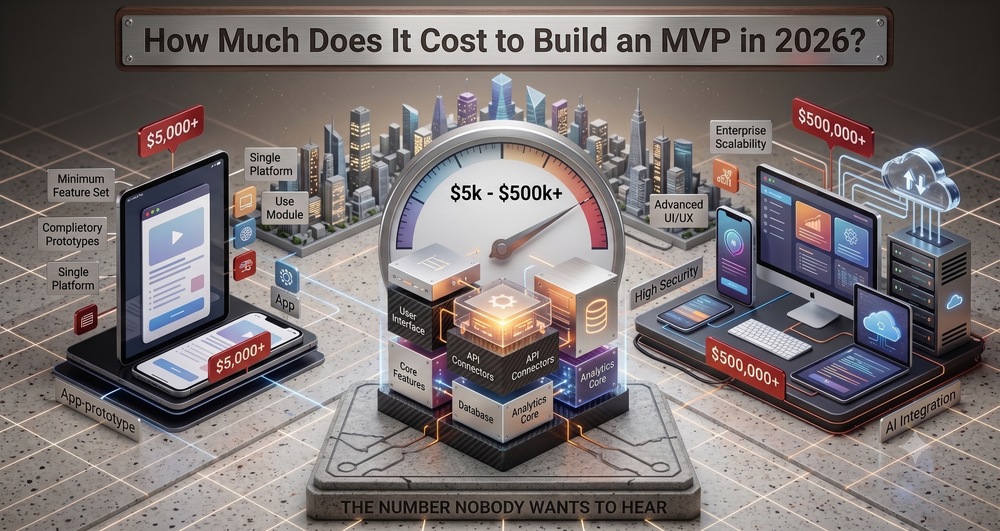
Everyone quotes a different number. Some say $5,000. Some say $500,000. Both are technically possible, which makes the question almost useless without context. Here is what actually drives the cost, and how to think about it before you spend a dollar.
The Number Nobody Wants to Hear
There is no standard price. An MVP is not a product category. It is a scope decision. Two founders can both call something an MVP and be describing projects that are six months and $80,000 apart in reality.
What you are really buying is answers to specific business questions. Does this solve a real problem? Will people pay for it? Can we acquire users? The cheaper you can answer those questions, the better your MVP strategy is, regardless of what you built.
What Drives the Cost
Four things move the needle more than anything else.
Complexity of the core feature set. An MVP with a single workflow, basic auth, and a dashboard is a completely different project from one that requires payment processing, third-party API integrations, real-time updates, and multi-user roles. Every feature you add is not just development time. It is also design time, testing time, and future maintenance.
Whether you need a mobile app. Web apps are almost always faster and cheaper to build first. If your MVP genuinely requires iOS and Android on day one, your costs roughly double compared to a web-only build. Most of the time, they do not require it. Users will tolerate a mobile-responsive web app if the product solves a real problem.
Who builds it. A freelancer in Southeast Asia charging $25/hour, a senior product studio in Europe charging $150/hour, and a US agency charging $250/hour will all quote the same project at wildly different numbers. The gap is not always quality. It is communication overhead, accountability, and how much hand-holding the engagement includes. Cheap rarely stays cheap when you factor in revision cycles, missed deadlines, and rebuilds.
How defined the scope is before work starts. Vague briefs produce expensive surprises. Studios and developers will pad estimates when requirements are unclear because they are protecting themselves. A tightly scoped spec with clear user flows and defined success criteria gets you sharper quotes and fewer change orders.
Real Price Ranges in 2026
Here is an honest breakdown by build type, assuming a reasonably scoped MVP with no exotic technical requirements.
A no-code or low-code MVP built on tools like Bubble, Webflow, or Glide, with minimal custom logic, runs $3,000 to $15,000 if someone competent is building it for you. If you learn the tools yourself, you can get it lower. These are good for validating a concept before committing to a full build.
A basic web app MVP, meaning custom code, one core workflow, simple auth, and a clean UI, lands between $20,000 and $45,000 with a decent studio or senior freelancer. This is the range Novion operates in for most early-stage clients. Timelines sit at four to eight weeks when the scope is locked.
A mid-complexity MVP with integrations, payments, user roles, or real-time features runs $45,000 to $90,000. At this level, you are building something that is closer to a v1 product than a true MVP. That is not always wrong, but founders should be honest with themselves about whether they actually need all of it before spending the money.
A full product build with mobile apps, complex backend architecture, or AI features baked in can push well past $100,000. This is where first-time founders often overspend before they have validated anything.
AI features specifically are worth calling out because they are everywhere now. Wrapping an LLM API into a product is not expensive. Actual custom AI development, fine-tuned models, proprietary data pipelines, that is a different story. If someone is quoting you $80,000 because they are going to "integrate AI," ask exactly what they mean.
Where Founders Waste Money
The most expensive mistake is building the wrong thing with high production quality. A polished MVP that solves the wrong problem is worse than a scrappy one that teaches you something.
Second most expensive: changing scope mid-build. Every time you add a feature after work has started, you are paying for the context switch, the re-architecture, and the lost time. Lock the scope. Ship it. Then iterate.
Third: hiring the wrong team and switching halfway through. A $15,000 offshore build that collapses at week six and requires a full rewrite costs you more than just the $15,000. It costs you three months of market timing.
Fourth: over-investing in design before you know what you are designing. UI polish is a conversion lever, not a validation tool. Users will forgive rough edges if the product works. They will not forgive a beautiful product that does nothing useful.
How to Calibrate Your Own Budget
Start with the question the MVP needs to answer. Write it down literally. "Does this workflow save accountants enough time that they will pay $50/month for it?" That question determines the minimum viable scope.
Then list the features that are strictly required to test that question. Not nice-to-haves. Not things that would be useful later. The minimum set.
Get two or three quotes from credible builders with that scope document. If the quotes vary wildly, the scope is not clear enough. Tighten it.
If your budget is under $20,000, no-code tools are your best path. Learn Bubble or find someone who knows it. You can get to real user feedback without custom code.
If your budget is $20,000 to $60,000 and you have a clean scope, a focused studio or senior freelancer can ship something real in six to eight weeks. This is the sweet spot for most non-technical founders.
If you are looking at spending over $80,000 on a first build, ask yourself whether you have enough evidence to justify that before launch. Usually the answer is no.
What You Are Actually Paying For
An MVP is not software. It is a learning instrument. The goal is not a working product. The goal is a decision, specifically, whether to keep going, pivot, or stop. Every dollar should be in service of reaching that decision faster and with more confidence.
The best teams do not just build what you spec. They push back when something is unnecessary, suggest cheaper paths to the same answer, and keep scope honest. That judgment is what you are paying for when you work with an experienced studio. It saves more money than it costs.
If you are trying to figure out what your specific MVP should cost and what scope actually makes sense, book a free call at novion.one.