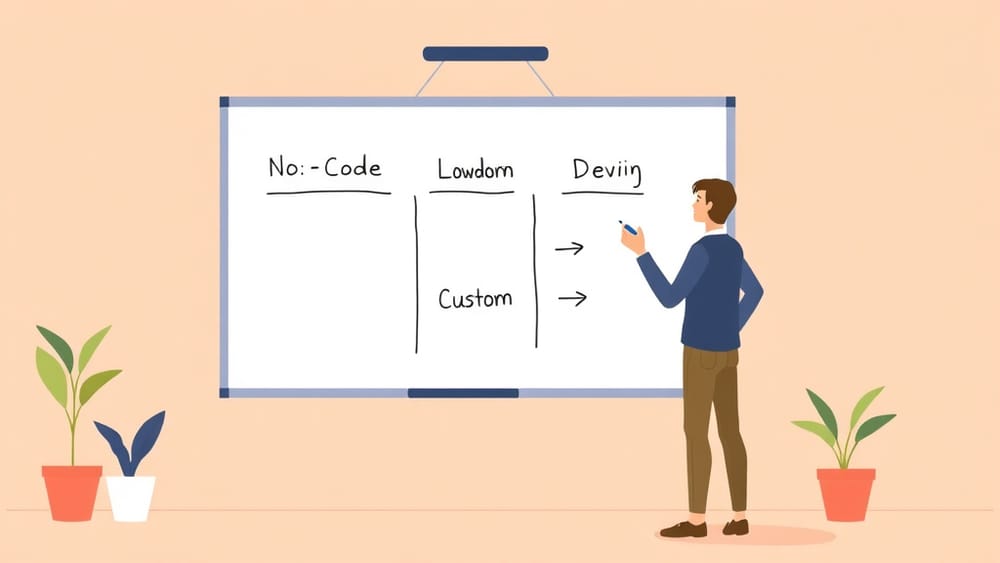
Most non-technical founders pick their build approach the wrong way. They either default to no-code because it sounds cheap and fast, or they get talked into custom development by an agency with a vested interest. Both paths can cost you a year and tens of thousands of dollars.
Here is how to actually decide.
The Landscape in 2026
75% of new applications now use some form of visual development, whether that is no-code, low-code, or a hybrid. That number sounds like a green light for Bubble or Webflow. But here is the stat that does not get quoted as often: 25 to 30% of no-code MVPs get rewritten in custom code within two years.
That rewrite is not free. It costs time, money, and momentum, usually at the worst possible moment, right when you are trying to scale.
The tools are not the problem. Picking the wrong tool for your specific situation is.
What Each Approach Actually Gets You
No-code (Bubble, Webflow, Glide, Softr) gets you to a working product in weeks with zero engineering overhead. It is genuinely good for validating whether anyone wants what you are building. The ceiling is real though. Complex logic, custom integrations, performance at scale, and anything requiring fine-grained data control will eventually fight you.
Low-code (Retool, Xano, WeWeb, Supabase-backed tools) gives you more flexibility. You can write logic where you need it and use visual tooling everywhere else. It suits internal tools, dashboards, and B2B products with moderate complexity. The tradeoff is a steeper learning curve and more dependency on specific platforms.
Custom development gives you full control over architecture, performance, and integrations. It is the right call when your product's core value depends on something no visual tool can replicate. It is the wrong call when you are still figuring out whether the market cares at all.
The Decision Framework
Ask these four questions in order.
1. Are you still validating the idea?
If yes, no-code or low-code almost always wins. Speed and cost of learning matter more than technical elegance right now.
2. Is your core value proposition a standard workflow, or something genuinely novel?
If it is a standard workflow, booking, marketplaces, directories, dashboards, visual tools can handle it. If your product's differentiation is the technical behaviour, you may need custom code from day one.
3. What does your data model look like at 10x your current scale?
This is the question most founders skip. If your data relationships are complex, hierarchical, or real-time, pressure-test your no-code tool against that reality before committing. A Bubble app with 50,000 rows behaves differently than one with 500.
4. What is the likely exit or growth path?
If you are building for acquisition or enterprise sales, buyers and procurement teams will ask about your stack. A no-code foundation is not a dealbreaker, but it can raise flags. If you are raising a seed round and planning rapid iteration, the ability to move fast matters more than stack prestige.
Where Founders Go Wrong
The most common mistake is choosing no-code because it is cheap upfront, without modelling the cost of the rewrite later. The second most common mistake is jumping to custom development before there is any evidence the product has legs.
There is also a middle path that gets underused: start with no-code to validate, then bring in engineers to rebuild the specific components that are holding you back, while keeping the rest. You do not have to rewrite everything.
At Novion, we see this situation regularly with early-stage founders. The right answer is almost never all-or-nothing. It is about sequencing your technical investment to match your business risk.
A Practical Rule of Thumb
If you have fewer than 100 users and no paying customers: no-code.
If you have users, some revenue, and a clear bottleneck that your current tool cannot solve: targeted custom development for that bottleneck.
If your product's core mechanic genuinely cannot be built in a visual tool, or if you are building for a regulated industry with strict security or compliance requirements: custom from the start.
Everything else is noise.
Building an MVP and not sure which approach fits your product? Book a free call at novion.one and we will give you a straight answer.