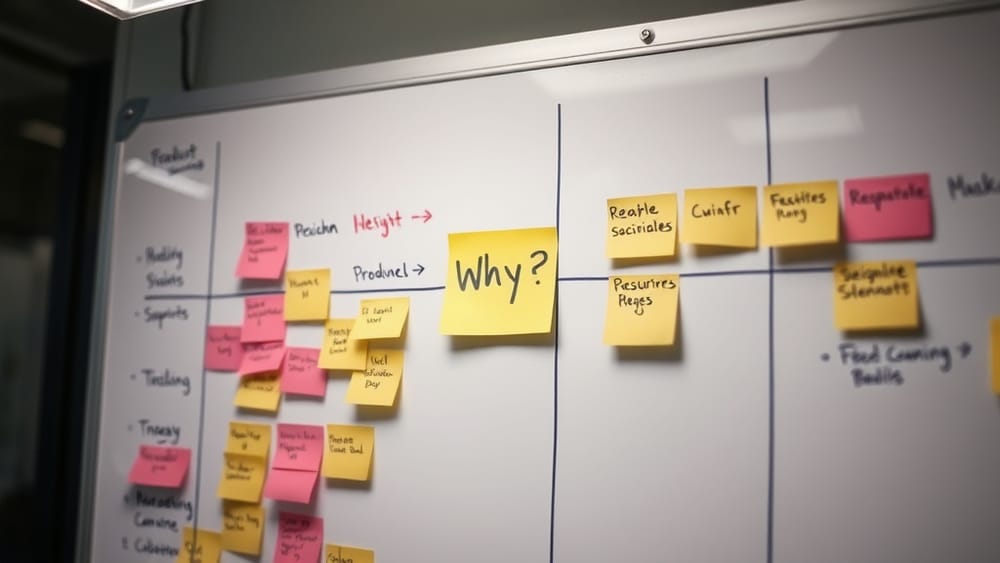
Most early-stage roadmaps are a ranked list of things the founder wants to build. That is not a roadmap. That is a wish list with a spreadsheet.
Features Are Not a Strategy
A real roadmap answers one question before anything else: why does building this next thing matter commercially? Not "users might like it." Not "our competitor has it." A commercial reason means you can finish this sentence: "We are building this because it will do X for revenue, retention, or risk reduction by Y."
If you cannot finish that sentence, you do not have a priority. You have a preference.
Most early-stage teams skip this step entirely. They debate effort versus impact, they stack-rank by gut feel, and then they wonder why the team keeps arguing about what to build next. The argument is not technical. It is political. And it is political because there is no shared standard for what "important" means.
Founder Instinct Is Real, But It Is Not a Plan
Non-technical founders often carry a strong product vision. That instinct is valuable. It got you to the starting line. But instinct without a hypothesis is not strategy, it is just confidence. And confidence does not survive a three-month sprint that moves none of your numbers.
A hypothesis looks like this: "We believe that adding X will reduce churn among users who reach the activation milestone, because they currently drop off at step three." That is testable. That is falsifiable. That gives your team something to build toward and something to evaluate afterward.
"I just think we need this feature" gives your team nothing except your authority, which wears thin fast.
Prioritization Debates Are a Symptom, Not the Problem
When teams argue about what to build, founders usually reach for prioritization frameworks. MoSCoW. RICE. Weighted scoring. These tools are not useless, but they treat the symptom. The actual problem is that everyone is optimizing for a different goal because the commercial goal was never made explicit.
At Novion, when we start an MVP engagement, the first thing we do is not wireframes or tech stack decisions. It is a single conversation: what is the one commercial outcome this build needs to prove or disprove in the next six weeks? Everything else is downstream from that answer.
When you have that answer, prioritization becomes mechanical. The feature that moves the needle on that outcome is in. Everything else waits. Disagreements shrink because there is a standard to measure against.
How to Add a Commercial Reason to Every Item
This does not require a full product strategy overhaul. Start small. Take your current roadmap and add one column: commercial justification. Force yourself to write one sentence per item. If you cannot write it, the item does not belong in the next cycle.
The sentence should reference one of three things: revenue impact, retention impact, or risk reduction. If the item does not touch any of those, it is probably a nice-to-have, which means it belongs at the bottom or off the list entirely.
Do this exercise with your team, not alone. The conversation it triggers is the point. You will quickly find out which items have real commercial backing and which ones exist because someone wanted them.
What This Fixes
When every roadmap item has a commercial reason, three things change. First, new feature requests get filtered immediately. "Can we add X?" becomes "What is the commercial case?" and half the requests die on the spot, which is the right outcome. Second, your team stops debating priorities and starts debating hypotheses, which is a much more productive argument. Third, you build a record of decisions that tells you why you built what you built, which matters enormously when you are reviewing what worked.
Bootstrapped founders especially need this discipline. You do not have runway to build things that do not move the business. Every sprint is a bet. Make sure you know what you are betting on and why.
Your roadmap should be a sequence of commercial bets, each with a hypothesis attached. Anything less is just a list of things you hope will matter.
Book a free call at novion.one and we will help you turn your wish list into a roadmap that actually moves the business.