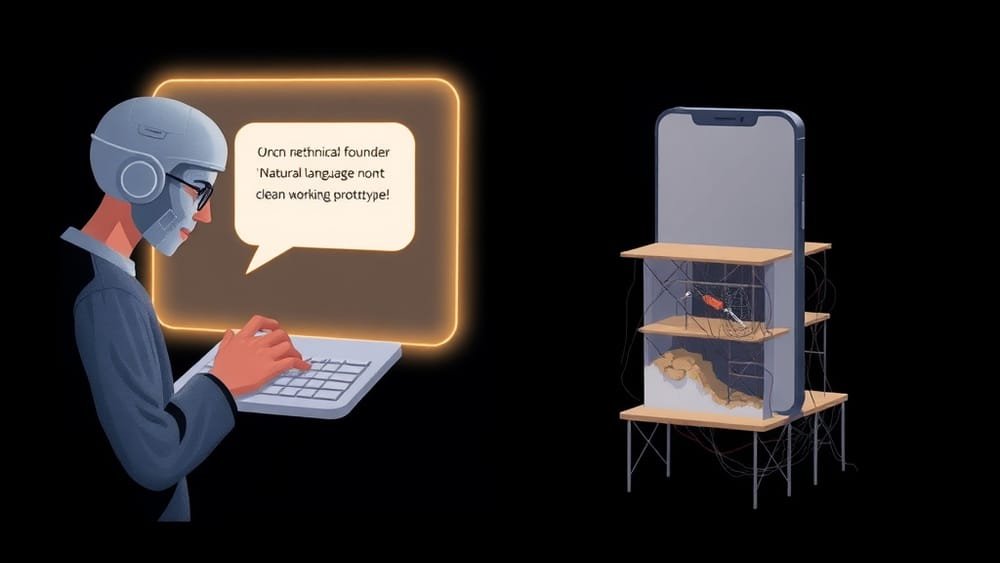
You can build a working app without writing a single line of code yourself. That is genuinely new. It is also genuinely dangerous if you do not know where the line is.
Vibe coding, prompting AI tools like Cursor, Lovable, or Bolt to build software through natural language, has handed non-technical founders something powerful: the ability to go from idea to working prototype without hiring a developer. That is worth taking seriously. So is the risk sitting underneath it.
What Vibe Coding Actually Gets Right
For early validation, it is hard to beat. You need to answer one question before anything else: does anyone want this? A vibe-coded prototype can answer that question in days instead of weeks.
If you are running user interviews, testing a landing page with a functional demo behind it, or trying to close your first three customers, a messy AI-generated codebase is not a problem. It is a tool. The mess does not matter yet.
The speed advantage is real. So is the cost advantage. If your prototype shows zero demand, you have lost a week and a few API credits instead of $30,000 and three months.
Where It Starts to Break Down
The problem is not the code AI writes on day one. The problem is what happens on day 30 when you keep building on top of it.
AI-generated codebases tend to have a specific failure mode: they are locally coherent and globally incoherent. Each individual piece looks reasonable. The overall architecture quietly accumulates contradictions. No single decision is catastrophically wrong. The compounding is.
Founders hit this wall when they try to add their second major feature, when they onboard their first paying users and something breaks under real load, or when they bring in a developer to help and that developer tells them the whole thing needs to be rewritten.
That rewrite conversation is expensive. Not just in money. In time, in morale, and in the trust of early customers who have already seen instability.
The Decision Framework: Should You Vibe Code This?
Three questions. Answer them honestly before you start.
1. Is this for validation or for production?
If the goal is to test a hypothesis, vibe code it. If the goal is to onboard paying customers to a thing they will depend on, you need more than vibes.
2. Do you have a developer who will review what gets built?
AI can write code. It cannot reliably audit its own architectural decisions. A developer does not need to write the code. They need to look at it. If no one technically literate is reviewing the output, you are flying blind.
3. What is the cost of a rewrite in six months?
For some products, a rewrite at the six-month mark is manageable. For others, it is company-ending. Know which one you are before you commit to a vibe-coded foundation.
If you answer these and the math still works, vibe code it. If it does not, you need a different approach.
What a Responsible Handoff Looks Like
The founders who use vibe coding well treat it as a phase, not a permanent state. They build fast to validate, then they pause and ask: what do we actually keep?
Sometimes the answer is most of it. Sometimes the answer is none of it, but now we know exactly what to build properly. Both of those are good outcomes.
At Novion, this is almost always the conversation we have with early-stage teams before they start building. Not whether to use AI tooling, but what to use it for and what to throw away afterward. The teams that skip that conversation are the ones calling us six months later asking how bad the damage is.
The honest answer is: sometimes recoverable, sometimes not.
The Real Risk Is Not the Code
The real risk is the false confidence. A working prototype feels like a finished product if you have never shipped a finished product before. It has buttons. It does things. Users can click around.
But working and production-ready are not the same thing. Security, scalability, maintainability, error handling: none of these are things vibe coding optimizes for. They are things you have to deliberately build in, and you cannot do that if you do not know they are missing.
Ship fast. Validate hard. But before you scale a single user onto a vibe-coded foundation, have someone who knows what they are looking at actually look at it.
If you are not sure where your build stands, or you want a second opinion before you go further, book a free call with us at Novion.