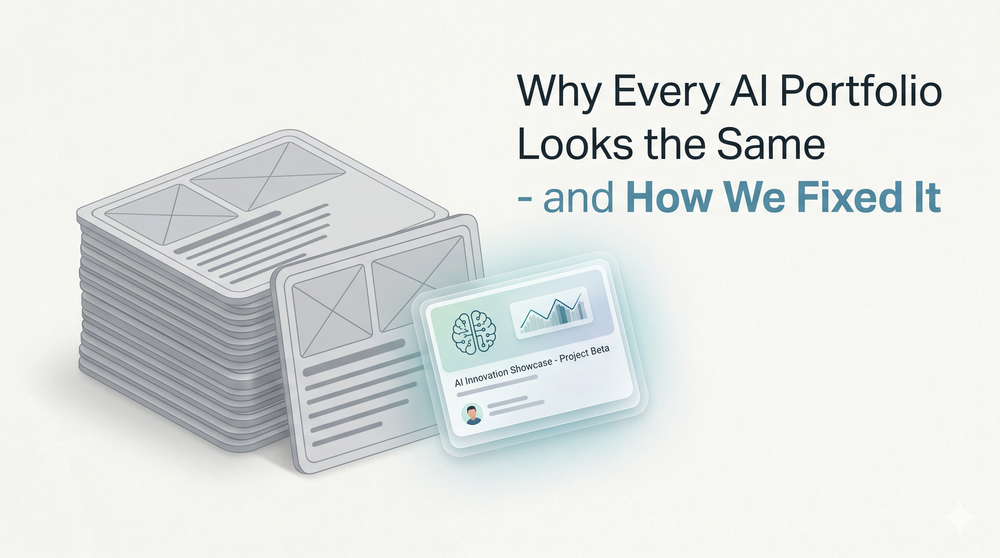
Purple gradient. Inter font. Four cards in a grid. Faint hover state if you're lucky.
You've seen this portfolio. You've probably made this portfolio. In 2026, it's the default output of almost every AI-powered portfolio builder on the market - and the root cause isn't that the model is bad at writing. It's that nobody thought carefully about where design should live.
The median problem
When you ask an LLM to generate a portfolio website, you get the aggregate aesthetic of its training data. Not someone's considered design taste. Not a deliberate layout decision. The statistical center of "what a portfolio website looks like."
That center, right now, is: dark gradient hero, bento grid body, Inter or DM Sans, a skills section that reads like a LinkedIn badge rack, and a contact form that goes nowhere. It's competent and completely forgettable.
A 2026 roundup of AI portfolio tools put it plainly: most still "churn out generic sites with identical bento grids, the same dark gradients, and interchangeable copy." Multiple independent reviewers flagged the same failure mode - not because AI is bad, but because every tool is asking it the same question and getting back the same answer.
Why "better prompts" don't fix it
The intuitive fix is to write a more specific prompt. Tell the model you want something bold, editorial, brutalist. And you'll get a bolder bento grid. Maybe the gradient will be teal instead of purple.
The problem is structural. LLMs are excellent at producing text - including text that describes styles and layout intent. They're significantly worse at translating that intent into HTML and CSS that holds together visually. Research on LLM UI generation consistently finds that models struggle with "design quality and consistency" and tend to produce output with "significant variance" across even similar prompts. Ask a model to design something, and it'll write you code for something. Whether those two things match is a different question.
The design problem is a placement problem
The reason a human designer can produce a distinctive portfolio in Figma or Webflow isn't that they have access to better components. It's that every decision - whitespace, type scale, color, motion - is intentional and held together by someone with taste.
That intentionality is what AI tools can't replicate in the generation step. But you don't have to put it there. You can put it upstream, before the model ever runs.
This is what we built around. The design doesn't come from the model. It comes from four hand-crafted HTML templates - each a real set of deliberate decisions, designed by a human, with constraints that make it visually coherent:
- Storytelling : first-person narrative voice, vibrant and Gumroad-inspired, built for writers and career storytellers
- Editorial Column : magazine layout with a serif drop cap, narrow reading column, for people whose work benefits from long-form positioning
- Terminal CLI : dark monospace, prompt-driven, blinking cursor, for engineers who want their aesthetic to match their stack
- Neo-brutalism : hard borders, offset shadows, oversized type, for designers who want their portfolio to make a statement before anyone reads a word
The model's only job is to write the copy - headlines, summaries, section labels - in the voice that matches the template. No HTML. No CSS. Just words.
Where uniqueness actually comes from
Picking a template isn't enough on its own. If everyone who uploads a developer CV gets the Terminal template with the same green-on-black palette and JetBrains Mono, you're back to the same problem at a different level of abstraction.
The variation comes from a seed roller that picks a palette and typography pair from each template's curated set, biased by signals in the CV itself. Engineers drift toward terminal archetypes and cooler palettes. Writers pull toward editorial layouts and warm serif pairings. The combination of archetype × palette × typography produces roughly 130 distinct base aesthetics before copy variance adds any further differentiation.
None of those 130 combinations require the model to make a design decision. They're all human decisions, made once, held permanently. The model picks up from a stable visual foundation and writes into it - which is exactly what it's good at.
What this means if you're building a portfolio
The insight generalizes. If you're going to use an AI tool to build a portfolio, the question to ask isn't "which tool has the best model?" It's "where does the design live, and who made those decisions?"
A tool that generates CSS from a prompt puts the design decision in the hands of the model. A tool built on hand-crafted templates puts it in the hands of whoever designed them. Those are not equivalent. Only one can give you a portfolio that doesn't look like everyone else's.
If you want to skip the research and just see what your CV produces, CV2Folio gives you one free portfolio on signup - 60 seconds from PDF to a finished HTML file you can host anywhere.